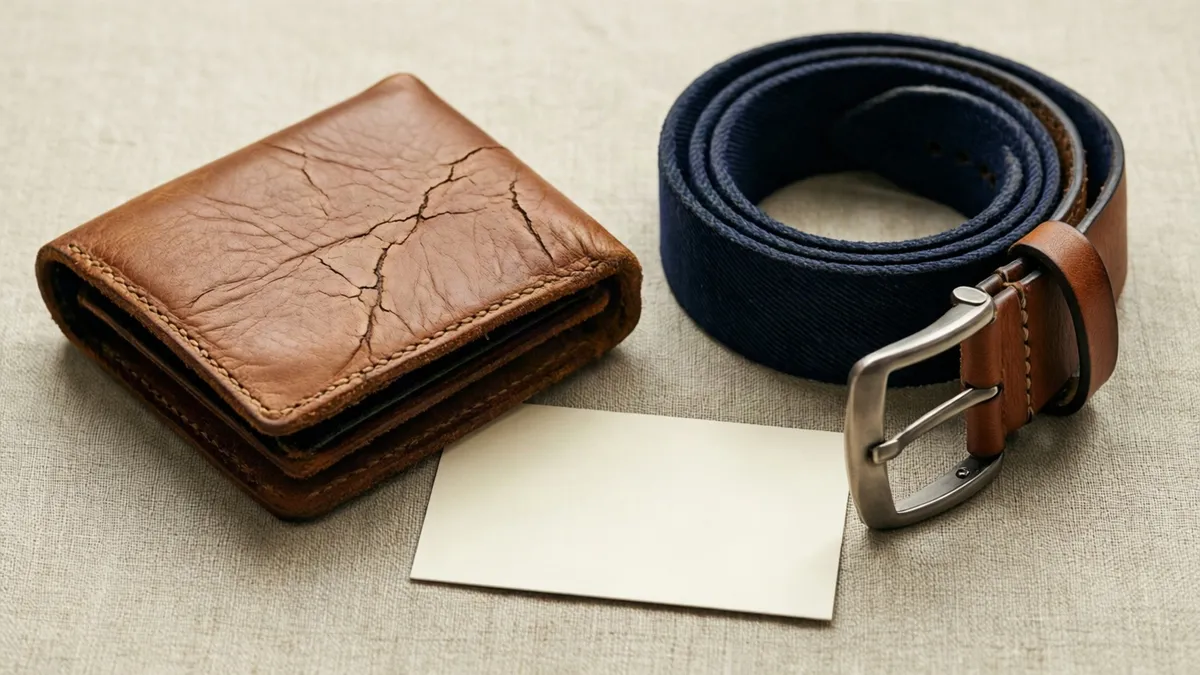
The short answer: when he has everything, the only gifts left are upgrades of the things he already uses and consumables he finishes without noticing. Do not introduce a new hobby, a new gadget, or a new interest. Find the one item that is worn, aging, or depleted and replace it. If there is no such thing, buy a service that removes something from his shoulders.
We write buying guides, not product reviews: we have not worn, carried, or used every product on this page. Materials and measurements are what the maker or the listing states, and prices, availability, and ratings change constantly — whatever Amazon shows when you click is the authoritative figure.
This article contains affiliate links. If you buy through one, we earn a small commission at no extra cost to you. We only recommend what we would suggest to a friend.
The Federal Trade Commission's endorsement guides, 16 CFR Part 255, require a disclosure like that one to be difficult to miss, so it sits above every link here. Our full affiliate disclosure has the rest.
Search "gifts for husband who has everything" and you will find the same page written twelve ways. A watch. A wallet. Whiskey stones. A leather journal. Every list assumes you have never bought for him before.
By year eight, the good categories are finished. The watch arrived three Christmases ago, the wallet before that, and the good headphones were a birthday two years back. If you have been buying across four fixed dates, the obvious gifts are gone and what remains is the harder question.
The National Retail Federation reported in 2025 that consumers plan to spend $890.49 per person on average on holiday gifts, food, decorations, and other seasonal items. That figure covers a household, not a husband. The question here is not how much to spend but what to spend it on when the categories are exhausted.
A husband who has everything needs the thing he already has
Replace, do not introduce.
That is the entire rule. A gift from a category he has never entered asks a question he already answered: no. He does not want a telescope, a bread machine, or a drone. He wants the thing he reaches for on Tuesday morning, in the version that does not have the crack, the stain, or the dead battery.
Walk through his day. What does he touch first? What does he grab on the way out the door? What is in his hand at 9 p.m. when he sits down? Those are your candidates. Not the thing he mentioned once in March. The thing he uses so often it has become invisible.
The Federal Trade Commission's Rule on the Use of Consumer Reviews and Testimonials went into effect on October 21, 2024, per the Federal Trade Commission. This rule is why we do not fabricate reviews or claim testing. What we can do is tell you how to read a listing: look for the material name in the product description, not the title. Full-grain leather refers to the top layer of the hide with its natural surface. Genuine leather means almost anything.
Copy this.
Our suggested replacement checklist:
- Name the object he touches daily. - Find the visible sign of wear. - Buy the same object, better made. - If there is no worn object, buy a consumable. - If there is no consumable, buy a service. - If none of these exist, you are shopping for someone else.
Pockets: where wear shows up first
Everyday carry is where wear lives. The items in his pockets take the most friction, the most oil, the most weather. They fail first, and because he uses them constantly, he has stopped seeing the failure.
A wallet whose leather has creased into a permanent fold. A belt where the holes have stretched and the edge has gone fuzzy. A watch strap with a crack across the first keeper. These are not defects he will mention. They are the background texture of a thing that works, barely, and he will carry it another year if you let him.
The table below is our editorial judgment. Price bands are ours, not a sourced figure.
| What he carries | Sign it is done | Replacement | Skip if |
|---|---|---|---|
| Bifold wallet | Leather cracked at the fold, stitching loose | Full-grain leather wallet, same fold style | He has moved to a cardholder or phone case |
| Leather belt | Holes stretched, edge fraying, crease set | Full-grain leather belt, single-prong buckle | He wears only stretch or canvas belts |
| Watch strap | Cracked, discolored, keeper torn | Same width, better material | He wears the watch on a metal bracelet |
| Sunglasses | Lenses scratched, hinges loose | Same shape, fresh pair, polarized | He wears prescription lenses only |
| Everyday bag | Zipper catching, lining torn, strap fraying | Same style, heavier construction | He does not carry one |
Our take: the wallet and the belt are the two replacements almost every husband needs and almost no husband buys for himself. If you can only pick one, pick the one he has carried longest. The watch strap is the cheapest fix and the one he will notice first, but only if you match the width to the millimeter.
Grill and kitchen: same motion, better metal
The grill is where husbands buy their own upgrades, which is exactly why yours needs you to do it. He bought the tongs he could find at the hardware store. He uses them every time. The spring is loose and the handles are blackened past cleaning, but replacing them never makes his list because they still work.
That is the pattern. The tool he reaches for first is the tool he will not replace, because functional is not the same as good. A wireless meat thermometer replaces the instant-read he has been using for years. This upgrade is not a new gadget, but a better version of the one he already owns. The motion stays the same. The result changes.
Same logic in the kitchen. If he cooks, he has a skillet. It is probably the one he bought in his twenties, with a wobble in the handle and a seasoning that went wrong in 2019. A cast iron skillet is not a new category. It is the same pan, made better, and he will use it the day it arrives because he already knows what it is for.
Steak knives are the other kitchen replacement. If he has a set, the serrations are dull. If he does not have a set, skip it. That is an introduction, not a replacement, and a good chef's knife already does the work.
The body and the robe: what exposure is depleted
Things that touch skin every day wear out quietly. A robe thins at the shoulders. Slippers compress at the heel until the sole is the only thing between his foot and the floor. A towel that was plush in year one is a rag in year five, and he will keep using it because it still dries.
These are the replacements he will not make. They are too personal to buy badly and too worn to ignore, which is what makes them the best gifts in this guide. The trick is sizing. A robe needs a chest measurement and a length. Slippers need a shoe size. If you cannot get those without asking, do not guess. Buy the consumable instead.
A massage gun sits in a different pocket. It is not a replacement for something he has, unless he already owns one that is dead, in which case replace it. If he does not own one, it is an introduction, and introductions are what this guide argues against. The exception: if he has mentioned muscle soreness more than twice, the need is already established. He just has not bought the tool.
A weighted blanket recommendation is typically based on body weight. If he sleeps poorly and has never tried one, it is an introduction with a stated need. If he has one and it has gone lumpy, it is a replacement. Read the listing for the weight recommendation, which is typically based on body weight, and do not guess.
One hobby he already has, one upgrade he wouldn't buy
The rule holds: one hobby, one upgrade. Not a starter kit. Not a new interest. The hobby he already has, in the version he would not buy for himself because the working version is good enough.
If he is a foodie, the upgrade is not a class or a subscription. It is the ingredient he uses but will not spend on. A bottle of the olive oil he reaches for, or the salt he has been buying in small bags. You are not teaching him to cook. You are stocking the pantry he already built.
For the tech guy, the upgrade is the cable, the charger, or the dock he has been making do with. He has the phone, the laptop, the headphones. What he does not have is the version that does not overheat, the one with enough ports, the cable that is not fraying at the strain relief. Replace the weak link in the chain he already owns.
An outdoorsman needs the base layer or the headlamp. He has the tent, the pack, the boots. The base layer is from 2018 and has lost its elasticity. The headlamp uses batteries he can never find. These are the items that fail on the trail and that he will not replace because the rest of the kit still works.
Travelers need the packing cube set or the carry-on with a broken wheel. He has the system. Improve the component that fails.
The builder or tinkerer needs the tool he borrows. Every maker has one. The thing he reaches for, finds missing, and substitutes with the wrong tool. Buy that one. Not a kit. The single tool that completes the set he has been making work without.
Adult building kits are the one place where the rule bends. If he has built sets before, a new one is a consumable. He finishes it, displays it, and it is done. If he has never built one, it is an introduction, and you are back to the original problem.
He finishes it every month: the consumable answer
Consumables are the only category that is objectively not an object.
What he consumes is proof of fit. If he drinks coffee every morning, a bag of good beans is not a guess. If he finishes a bottle of whiskey every few months, the next one is not a risk.
A pour-over kettle is the one hardware upgrade that works here, because it serves the consumable. If he already makes pour-over coffee with a standard kettle, the gooseneck is a better version of the same motion. If he does not make pour-over, skip it. You are introducing a method, not upgrading a tool.
Coffee subscriptions work when you know what he drinks. Not the brand. The roast level, the origin he prefers, whether he grinds or buys pre-ground. If you do not know, buy a single bag from a roaster and watch what he does with it.
A hot sauce gift set is the same logic. If he has a shelf of hot sauce, he will use a set. If he has one bottle that has been in the fridge door for two years, he will not.
Whiskey and alcohol gifts are where the category gets noisy. A decanter is an object, and a decoration, and he probably has one. A bottle of what he already drinks is a consumable. A bottle of what he has never tried is an introduction. Know which one you are buying.
For the holidays, the United States Postal Service recommends sending USPS Ground Advantage and First-Class Mail by December 17. This ensures expected delivery before December 25 in the contiguous U.S., per United States Postal Service, 2025. Priority Mail has a December 18 cutoff, and Priority Mail Express December 20. These dates matter most for consumables, which often ship from smaller producers with slower fulfillment.
When the right gift for a husband who has everything is not an item
Sometimes there is no worn object, no depleted consumable, and no upgrade that fits. That is the moment to stop shopping for objects and start shopping for time.
A service is the gift that removes something from his shoulders. House cleaning, lawn care, a car detail, a meal delivery. These are not romantic, and they are not supposed to be. They are the equivalent of the consumable. Something he needs done, that he will not pay someone else to do, and that you can pay for once.
Experience gifts work when the experience is something he would book himself but has not. Not a surprise trip. That is an obligation wearing a bow. A voucher for a category he already chooses, whether that is a concert, a round of golf, or a class, gives him the decision rather than the date.
Gift cards are the honest answer when nothing else fits. They are not a failure. They are an admission that he knows what he needs better than you do, and a digital gift card gives him the range to act on it.
Now, the money question. You are buying this from an account he can see, with money that is already his. The Internal Revenue Service states that gifts to your spouse are not taxable gifts, so the transaction is not a transfer. It is a redirection of shared resources toward something he would not buy for himself. That is what a gift is in a long marriage, and saying it plainly does not diminish it.
For larger gifts from separate funds, the same IRS guidance reported in 2026 sets the annual gift tax exclusion at $19,000 per donee, per Internal Revenue Service. Between spouses, it does not apply. Know the rule, then forget it.
Sentimental objects deserve a warning. A custom book, an engraved item, a framed photo. These are not replacements and not consumables. They are introductions of a different kind, and they work only when the sentiment is specific enough to surprise him. Generic warmth does not. If you cannot write one page that would make him laugh or stop, skip the format.
What gifts should I avoid buying for a husband who has everything?
Avoid anything that introduces a new category: a hobby starter kit, a gadget he has never mentioned, an interest he has never shown. Skip decorative objects with no function, anything that needs a shelf, and anything that requires him to learn a new skill to use it. The one exception is an adult building kit, which functions as a consumable because he finishes it and it is done.
Is it better to buy one expensive gift or several smaller ones for a husband who has everything?
One good replacement beats three small introductions. A replacement settles something. Multiple small gifts multiply the number of new categories you are asking him to care about. If the budget is under $50, one consumable he already uses is better than a basket of things he does not.
Do subscription gift boxes get cancelled after the first few months?
A subscription works when it refills something he already runs through, and fails when it introduces a category he has no use for. If you are unsure whether he will keep it, buy one month, not twelve. The first delivery tells you whether the second is a gift or a chore.
Are experience gifts more appreciated by husbands than physical gifts?
The decision is individual, not statistical. An experience works when it matches a choice he already makes for himself, and fails when it is a surprise that creates an obligation. A concert voucher for someone who already buys tickets is an upgrade. A surprise weekend for someone who does not travel is an introduction.
How much should I spend on a gift for a husband who has everything?
The NRF average of $890.49 per person covers an entire household across the holiday season, not a single gift. There is no rule for how much to spend on him. The right amount is what the replacement or consumable costs, plus whatever feels like attention rather than obligation.
Beatriz Nunes writes buying guides, not reviews; nothing here was tested by us.
Sources
- Internal Revenue Service — "Frequently asked questions on gift taxes" (https://www.irs.gov/businesses/small-businesses-self-employed/frequently-asked-questions-on-gift-taxes) Retrieved 2026-08-22.
- National Retail Federation — "Winter Holidays Data and Trends" (https://nrf.com/research-insights/holiday-data-and-trends/winter-holidays) Retrieved 2026-08-22.
- Federal Trade Commission — "The Consumer Reviews and Testimonials Rule: Questions and Answers" (https://www.ftc.gov/business-guidance/resources/consumer-reviews-testimonials-rule-questions-answers) Retrieved 2026-08-22.
- Federal Trade Commission — "Guides Concerning the Use of Endorsements and Testimonials in Advertising" (https://www.ftc.gov/legal-library/browse/federal-register-notices/guides-concerning-use-endorsements-testimonials-advertising) Retrieved 2026-08-22.
- United States Postal Service — "USPS Recommends 2025 Holiday Mailing and Shipping Dates" (https://about.usps.com/newsroom/national-releases/2025/0917-usps-recommends-2025-holiday-mailing-and-shipping-dates.htm) Retrieved 2026-08-22.
- National Retail Federation — "Consumers to Spend Second-Highest Amount on Record, According to NRF Holiday Survey" (https://nrf.com/media-center/press-releases/consumers-to-spend-second-highest-amount-on-record-according-to-nrf-holiday-survey) Retrieved 2026-08-22.
- United States Postal Service — "2025 Holiday Mailing and Shipping Dates" (https://about.usps.com/postal-bulletin/2025/pb22688/html/cover.htm) Retrieved 2026-08-22.