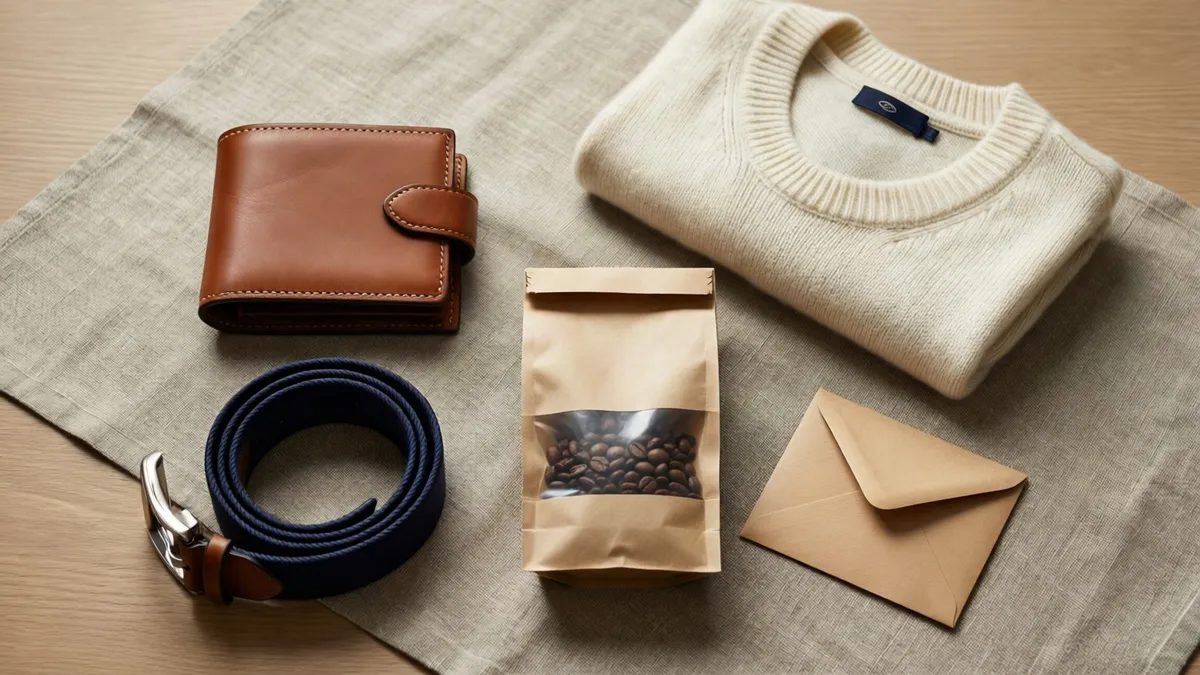
The short answer: for a husband who already owns the tools, the gadgets, and the loungewear, the birthday gift is not a new object. It is the removal of a decision, a single superior version of what he already uses daily, or an experience that leaves no trace. This guide replaces stuff with strategy.
We write buying guides, not reviews. We have not used every item on this page. Specifications come from the manufacturer or the listing, and whatever Amazon shows when you click is the authoritative figure.
This article contains affiliate links. If you buy through one, we earn a small commission at no extra cost to you. We only recommend what we would suggest to a friend.
The Federal Trade Commission's endorsement guides, 16 CFR Part 255, require a disclosure like that one to be difficult to miss, so it sits above every link here. Our full affiliate disclosure has the rest.
Standard birthday gifts for husband listicles assume a first-time buyer. A wallet. A watch. Whiskey stones. By year eight, those categories are finished, and if you want the broader argument, our pillar guide Gifts for a Husband When the Obvious Ones Are Gone starts where those lists stop. This page narrows to the birthday and the repeat buyer.
The birthday gift is not a thing
He has the headphones. He has the watch. He has the grill, the good knife, and three hoodies he actually wears. Another object in that house is not a gift. It is inventory.
Birthday gifts for a husband in this position are not about finding something he lacks. They are about removing a decision he has been avoiding, or replacing something he uses daily with the version he would not buy for himself. The object, when there is one, is the vehicle. The gift is the noticing.
This is where Gifts for a Husband Who Has Everything: What Is Left still shops for an object. Here, the strategy comes first. You are not browsing. You are identifying which of his daily frictions you can pay someone else to remove.
The repeat buyer does not need more stuff. He needs someone to notice what he keeps not replacing, what he keeps meaning to book, what he keeps putting off.
Ask the question he answers with a grunt
He says he does not need anything. He means it. The problem is that "nothing" is not a category you can shop, so you need to convert it into one.
Ask the right question. Not "what do you want for your birthday," because that is a question he has to answer with a shopping list he does not have. Ask about friction instead:
- What is the one thing you keep meaning to fix, replace, or book, and have not gotten around to?
- What is the thing you use every day that you would never spend money to upgrade?
- If someone handed you a free Saturday with no errands, what would you do with it?
- What did you recently throw out or wear through that you have not replaced?
- What is the last thing you borrowed instead of buying?
One answer from that list gives you a category. The birthday gift is the category, not a guess.
Do not ask all five. Pick one or two, ask in passing, and let him answer badly. A grunt counts as data. "I dunno, the couch" means the couch is the gift territory. Useful Gifts for Husband: Replace, Do Not Introduce makes the case for this approach: replacing something he already chose beats introducing something he has not.
The subscription that ends itself
A subscription is a gift that arrives without a shelf. For a man whose house is full, that is the point.
Coffee is the obvious one. He already drinks it, he already has opinions, and a specialty coffee subscription delivers something he will use up rather than store. The listing states the roast schedule and origin rotation. Read those for whether it matches his taste.
A streaming service he keeps borrowing from a friend. A meal kit that removes the Wednesday grocery decision. A blade replacement plan for the razor he already uses. Each one ends itself: the coffee runs out, the credit depletes, the old blades go in the bin.
A physical gift accumulates. A subscription cycles. For the repeat buyer who has no space left, the cycling is the feature, not the bug.
One caution. A subscription that auto-renews on your card is a gift that keeps charging. Check the terms, set a calendar reminder, and cancel before it becomes a line item he notices. The gift is the first delivery cycle, not a permanent obligation.
The one upgrade he won't justify
He owns a wallet. He owns a belt. He owns a jacket. The versions he owns are probably fine, which is exactly why he will not replace them. That is your opening.
The upgrade is not about brand. It is about material, and the listing tells you what you need to know. Full-grain leather means the top layer of the hide, with the natural grain intact. It ages rather than wears out. Bonded leather means scraps pressed together with adhesive, and the listing will say so if you look. A full-grain leather bifold wallet in the $60 to $120 range is the kind of thing he would use for a decade but would not buy for himself.
Price bands below are ours, not a sourced figure.
The same logic applies to apparel. A merino wool sweater costs more than the cotton one he wears, but merino regulates temperature, resists odor, and does not pill the way synthetics do. The listing states the wool weight in grams per square meter; higher numbers mean denser fabric. A full-grain leather belt replaces the one he has been reusing past its last hole.
The upgrade works because he already settled the question of whether that object belongs in his life. You are not introducing. You are replacing, with a better version of the same thing.
The experience that leaves no trace
An experience feels like a cop-out to the wife who wants to hand him something. It is not, if you pick the right one.
The wrong experience is a vague promise. "We will do something fun" is not a gift; it is a plan he now has to make. The right experience is booked, dated, and paid for before he opens the card. A restaurant reservation for the two of you. A Saturday at a range he has mentioned. A guided fishing morning. The specificity is what makes it a gift rather than a suggestion.
Experiences work for the repeat buyer because they leave no object behind. No shelf space, no storage decision, no guilt about the thing he never uses. The memory is the only artifact.
Do not book something that requires him to learn a skill he has not expressed interest in. A cooking class for a man who does not cook is a chore, not a gift. Match the experience to something he has already shown he likes, and the absence of a physical object stops mattering.
If he genuinely wants something to unwrap, pair the experience with a small, related object. The reservation printed on good paper. A guidebook for the trip. The object is the wrapping.
The maintenance pass: a birthday gift of time
Everything he owns needs servicing. The watch needs a movement check. The boots need leather conditioner and resoling. The knives need professional sharpening. He knows this. He has not done any of it.
The maintenance pass is the gift of doing that for him. Take the boots to a cobbler. Drop the knives at a sharpener. Book the watch service. He does not have to decide, schedule, or remember. You have already done it.
This is not a glamorous gift. It will not photograph well. But it extends the life of the objects he already chose, which is the most practical form of care you can show for a man who has finished buying.
The cost varies. A cobbler resole runs in the $40 to $80 range. A professional knife sharpening is often under $20 per blade. Call the shop, ask the price, and book it. The receipt is the gift card.
When the birthday gift is a decision removed
The most powerful gift for the repeat buyer is not an object, a subscription, or an experience. It is the removal of a task he has been avoiding.
Not a vague offer to help. A specific, time-bound intervention. You booked the dentist. You called the plumber. You filed the paperwork. You renewed the registration. The task is done, and the receipt or confirmation is the gift.
This works because the man who has everything still has obligations, and obligations are the one category he cannot buy his way out of. You are not giving him a thing. You are giving him back an evening.
Be concrete. "I took care of the car inspection" is a gift. "I will help with whatever you need" is not, because it returns the decision to him, which is the opposite of the strategy.
Strategy comparison
| Strategy | Best when | What you hand him | Our cost judgment |
|---|---|---|---|
| Subscription | He has no space and a daily habit | First delivery, with cancel date noted | $20 to $60 per cycle |
| Single upgrade | He uses a daily object he will not replace | The better version, same category | $60 to $150 |
| Experience | He wants time, not things | A booked and dated reservation | Varies by event |
| Maintenance pass | His good stuff is wearing | A receipt from the cobbler or sharpener | $20 to $80 |
| Decision removed | He is deferring a specific task | A confirmation email or receipt | Free to cost of task |
Price bands in the table are ours, not a sourced figure.
Our suggested birthday-gift decision checklist (copy this):
- He already owns the category I am considering. Do not introduce.
- The gift removes a decision, a task, or a daily friction.
- If it is an object, it replaces something he already uses.
- If it is an experience, it is booked and dated before his birthday.
- If it is a subscription, I know the cancel date.
Our take: If he genuinely has no space, the subscription or the decision removed is the call, because both disappear without leaving clutter. If he wants something to unwrap, the single upgrade is the strongest play, since it replaces something he already chose rather than asking him to adopt something new. The experience and the maintenance pass are the right answer for the man who values time over objects, but only if they are booked before he opens the card.
Frequently asked questions
What is a reasonable amount to spend on my husband's birthday gift?
There is no rule, but the useful frame is this: spend enough that he would not have spent it on himself. For a daily-use upgrade like a wallet or a belt, that is often $60 to $120. For an experience or a maintenance pass, the cost of the service is the budget. The amount matters less than the specificity of the noticing behind it.
Does my husband actually use the kind of gadget gifts this type of guide always recommends?
Probably not, if he already owns the gadgets. The repeat buyer's house is full of last year's recommendations. This is why this guide argues against adding new objects and toward replacing, servicing, or removing decisions instead. A gadget he has to learn is a chore, and a chore is not a birthday gift.
Is a gift experience better than a physical present for a birthday?
It can be, but only if it is booked and dated before the birthday. A vague promise to "do something" is a plan he has to make, which is the opposite of a gift. The experience works when the reservation is already in his calendar and the only thing he has to do is show up.
What do I gift a husband who has already bought every tool and gadget?
You stop shopping in those categories. If the five conversation questions above draw blanks, the maintenance pass is the safest default, because every man owns something that needs servicing and has not gotten around to it. The strategies in this guide exist precisely because the tool and gadget categories are closed for him.
Can I plan a celebration or trip instead of buying a gift without it feeling like a cop-out?
Yes, if the trip is booked and paid for before his birthday. The cop-out is not the absence of a physical object; it is the absence of a decision already made. A printed itinerary in a card is a gift. A suggestion that you should take a trip sometime is not.
Beatriz Nunes writes buying guides, not reviews; nothing here was tested by us.
Sources
- Federal Trade Commission — "Guides Concerning the Use of Endorsements and Testimonials in Advertising" (https://www.ftc.gov/legal-library/browse/federal-register-notices/guides-concerning-use-endorsements-testimonials-advertising) "Retrieved 2026-08-23".